Ductless mini splits, explained
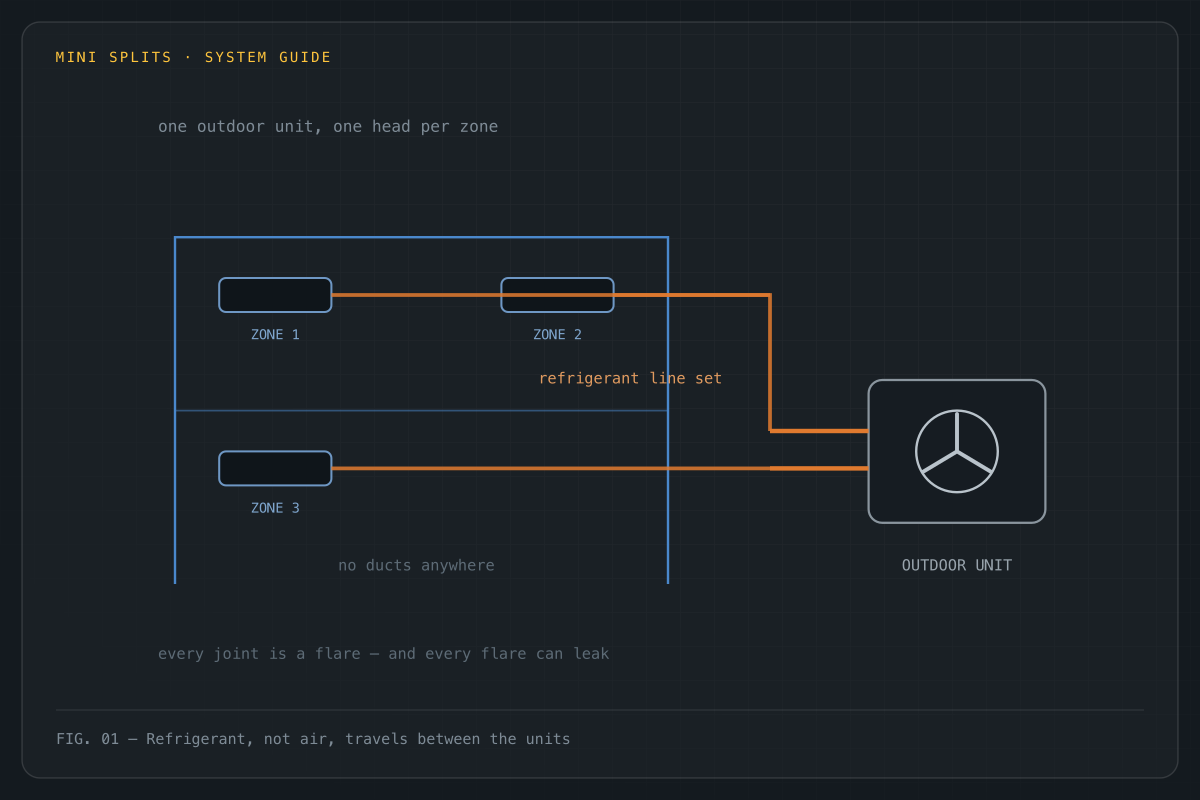
A ductless mini split heats and cools without ductwork — an outdoor unit connects by a refrigerant line to one or more indoor heads mounted on walls or ceilings, and each head controls its own zone.
That is the whole point. Nothing is blown through a duct system, because there is no duct system.
Nearly every mini split is a heat pump. It heats in winter from the same box.
Each head is its own thermostat. That is the feature people buy, and the thing that complicates it.
What a mini split is, and what it is not
A mini split moves refrigerant to each room instead of blowing air to each room. Remove the ducts and everything else follows.
A central system conditions air in one place and then spends a great deal of energy pushing it around a house through sheet metal. A mini split does not. The outdoor unit sends refrigerant through slim copper lines directly to a head in each room, and that head does the conditioning where you stand. There is nothing in the attic, nothing in the crawlspace, and nothing to leak air into either.
On this page
Two things surprise new owners. The first is that nearly every mini split is a heat pump, so the same box that cools in July heats in January — the mechanism is on how a heat pump works, and it is identical. The second is that a mini split is not one system with several vents. It is several small systems that happen to share an outdoor unit, and that distinction drives everything on this page.
Zones: the choice that defines a mini split
One head is one zone. How many zones you hang off a single outdoor unit is the decision that shapes cost, comfort and reliability.
Single-zone
- One outdoor unit, one indoor head, one room.
- The outdoor unit is sized for exactly that room's load, so it modulates down comfortably when demand is light.
- If it fails, one room is affected. If you add a room later, you add a separate system.
- More outdoor units and more wall penetrations — the untidy option that technicians quietly prefer.
Multi-zone
- One outdoor unit feeding several heads, commonly up to five to eight.
- Each head has its own control, so bedrooms and living rooms hold different temperatures.
- One outdoor unit, one set of penetrations, one place for the equipment to live.
- The catch: when a single small head calls, the shared outdoor unit may not turn down far enough to serve it well.
That last point deserves its own sentence, because the sales literature never contains it. A multi-zone outdoor unit has a minimum output it cannot go below. If the only head asking for cooling is a small bedroom, the unit overshoots, shuts off, restarts, and overshoots again. The result is a house that costs more to run and feels worse than the single-zone systems it replaced. It is a genuine, well-known trade-off — ask any technician why they are lukewarm about large multi-zone installs — and it is the reason several single-zone systems sometimes beat one elegant multi-zone. Our multi-zone guide works through how many zones actually make sense.
Where ductless fits, and where it does not
Ductless earns its price where ducts are absent, impossible, or beside the point.
Where it fits
- Houses with no ductwork at all — radiators, baseboards, or an old house that never had forced air.
- Additions, garages, sunrooms and attic conversions, where extending ducts is expensive or impossible.
- Room-by-room zoning, when one bedroom bakes and the living room freezes.
- Supplementing a central system in the one room it never gets right.
Where it does not
- Whole-house comfort in a home that already has good ductwork — you would be paying to solve a solved problem.
- Anyone who cannot accept a visible head on the wall of every conditioned room.
- Low-load rooms on a multi-zone outdoor unit, which struggles to turn down far enough to serve one small head well.
- Owners who will never clean a filter. A neglected head grows mildew faster than a ducted system does.
The clarifying question is not "is ductless good?" It is "what would ducts cost me here?" In a 1920s house with radiators, running ductwork means soffits, dropped ceilings and lost closets, and ductless wins before the first quote is written. In a 2005 house with sound ducts already in the attic, the same money buys a ducted heat pump that nobody has to look at.
Three parts, and a joint that leaks
Outdoor unit, line set, indoor head. Most mini-split faults live at the connections between them, not inside them.
| Part | What it does | Where | What you notice when it fails |
|---|---|---|---|
| Outdoor unit | Compressor and coil, the same job they do on any heat pump | Outside | Nothing runs anywhere; or it runs while no head blows |
| Line set | Two insulated copper lines carrying refrigerant to each head | Through the wall | Ice on the copper, weak output, a slow loss of capacity |
| Flare connections | The cone-shaped joints where copper meets the equipment | Both ends | The commonest leak point on a mini split, and it is an install-quality issue |
| Indoor head | A coil, a long blower wheel, a filter and a drain pan in one slim box | On the wall | Dripping water, a musty smell, or a blinking fault light |
| Condensate drain | Carries the water the coil pulls from your air, usually by gravity | Behind the head | Water running down the wall — the single most routed mini-split call |
| Inverter board | Varies compressor speed instead of switching it on and off | Outdoor unit | Error codes, short cycling, or a system that never reaches setpoint |
Note the third row. A flare is a cone machined into the end of a copper tube by hand, on site, and tightened to a torque spec. Under-tighten it and it weeps refrigerant for years; over-tighten it and the copper splits. It is the most common leak point on a mini split, and it has nothing to do with the brand you bought.
The indoor head is a wet, dark box
Two of the three most common mini-split service calls are about water, and both are preventable.
Every cooling coil condenses water out of the air passing over it. In a furnace that water drains away in a basement where nobody sees it. In a mini split it happens inside a slim plastic box screwed to your living-room wall, a few feet above the floor. That single fact explains the smell, the drips, and most of the maintenance.
- The filters
Two plastic mesh screens behind the front flap. They are washable, and they are the only maintenance most owners ever do.
What it means for youRinse them every 4–8 weeks in cooling season. A blocked filter starves the coil and starts the whole chain below.
- The drain pan and line
The coil condenses water out of your room air; it collects in a shallow pan and leaves through a hose, almost always by gravity.
What it means for youA clogged, kinked or badly pitched drain line backs water up into the head — and it runs down your wall. This is the most common service call on a mini split.
- The blower wheel
A long cylindrical fan that sits permanently damp inside a dark box.
What it means for youMildew grows on the wheel and coil. That is the musty "dirty sock" smell on start-up. It needs a proper deep clean, not a spray.
- The condensate pump
Where gravity cannot do the job — a ceiling cassette, or a head below the drain exit — a small pump lifts the water instead.
What it means for youOne more thing to fail, and it fails loudly or wetly. Gravity drainage is worth designing for at install time.
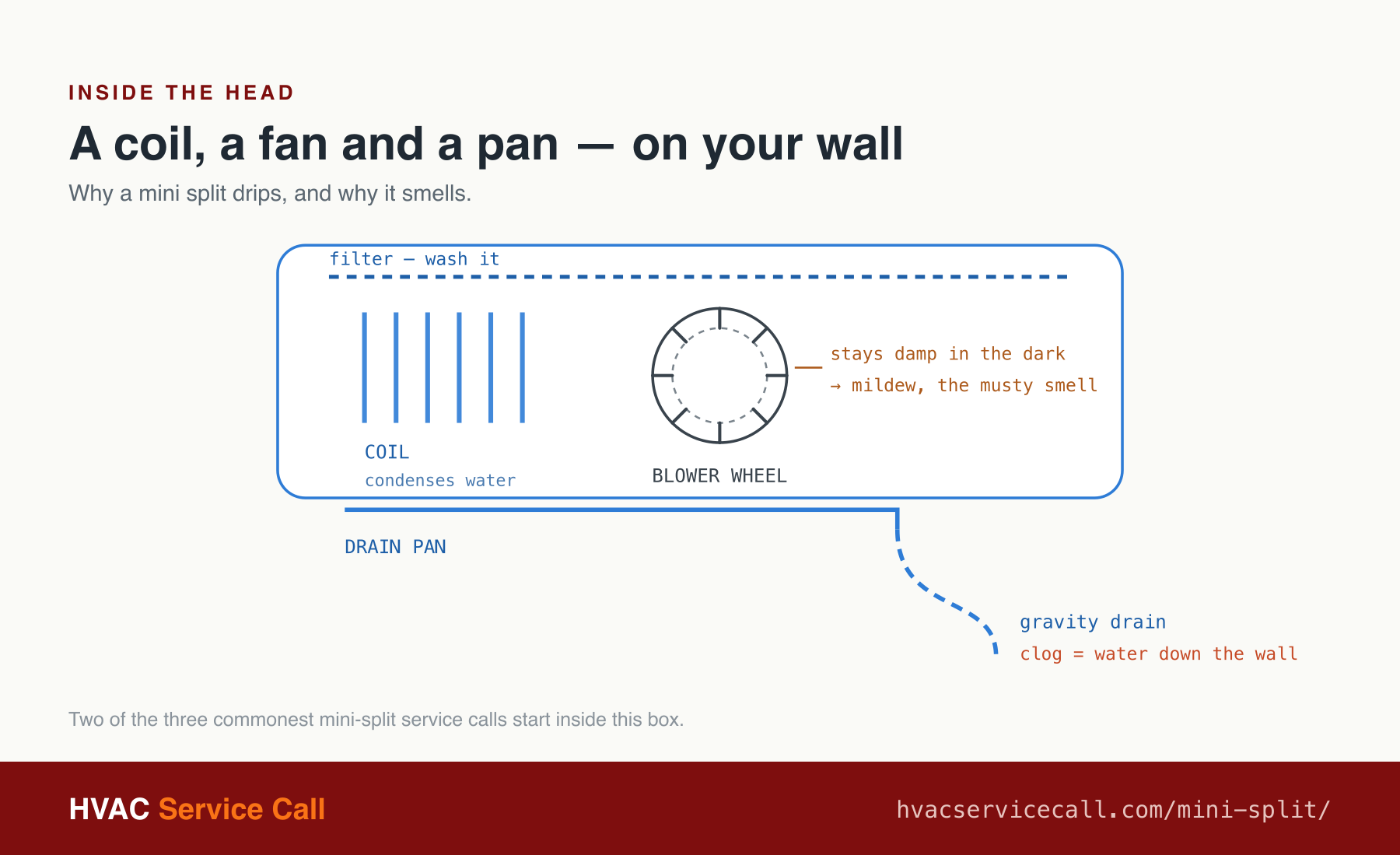
Spraying a coil cleaner through the front grille does very little, because the mildew is on the blower wheel behind it — a long cylinder with dozens of narrow blades that stays damp between cycles. A real cleaning means covering the wall, partially dismantling the head, and washing the wheel and coil properly. It is a service, not a chore, and it is why a mini split wants professional attention more often than a furnace does.
What it costs, counted per zone
Price scales with heads, not with square feet. Every zone you add is most of a system.
Bryant puts an installed zone at roughly $2,000 to $7,000, and the count of indoor heads drives that total more than anything else. This is the opposite of how central systems price: adding a room to a ducted system means a duct run and a register, while adding a room to a mini split means most of another machine. It is also why the honest comparison against ducted equipment happens at three or four zones, not at one.
Equipment tiers exist and they are real — Mitsubishi, Daikin and Fujitsu at one end, budget brands at the other, and DIY-oriented kits somewhere alongside. We route repairs and do not sell equipment, so we will not rank them. What we will say is that on a mini split, installation quality predicts reliability more strongly than brand does, for the reasons in the next section.
Why installation quality decides everything
Three install details — the flares, the vacuum, and the drain pitch — cause most of the faults this page describes.
A mini split arrives as separate pieces, and the installer creates the sealed system on your wall. The copper is cut and flared by hand. The line set must be evacuated to pull out air and moisture before refrigerant is released into it. The drain hose has to fall continuously, with no dips or kinks, from the pan to the outdoors. Get those three right and the system is famously reliable. Get them wrong and you have a slow refrigerant leak, an acidic system that eats its own compressor, and water down the wall — respectively, and sometimes all three.
Pre-charged kits with quick-connect fittings are a real product, and homeowners do install them. Be clear about what you are accepting: you are performing the flare and drain work that determines the system's life, without the tools that verify it. And the moment refrigerant must be added, recovered, or diagnosed with gauges, the work is legally restricted to EPA Section 608–certified technicians. Repairs, in particular, are not a DIY category.
When something goes wrong: symptom, likely cause, where to read next
A mini split tells you more than a furnace does — the head blinks its own fault code before anyone opens anything.
| What you notice | Likely cause | Check yourself first | Read next |
|---|---|---|---|
| Water dripping from the indoor head | Clogged drain line · dirty filter · bad pitch | Wash the filters, then look for a kinked drain hose | Mini split repair → |
| A musty smell each time it starts | Mildew on the blower wheel and coil | Run fan-only for an hour to dry it; then book a deep clean | Mini split repair → |
| A blinking light on the head | An error code — the unit is naming its own fault | Count the blinks and note the pattern before calling | Mini split repair → |
| One head does nothing, the others are fine | Head control board · communication wiring · expansion valve | Fresh batteries in that head's remote | Mini split repair → |
| Weak output, ice on the copper lines | Low refrigerant — usually a flare joint | Wash the filters first; ice can be pure airflow starvation | Mini split repair → |
| Outdoor unit runs, no air from any head | Communication fault · outdoor control board | The breaker, and whether the heads power up at all | Mini split repair → |
| Multi-zone: high bills, poor comfort on one head | Low-load short cycling | Watch how often the outdoor unit stops and restarts | Mini split repair → |
Washing the filters, drying the head on fan-only, checking the breaker and reading the blink code are yours. Refrigerant is not: handling it legally requires EPA Section 608 certification, and a flare leak needs finding rather than topping up. Do not push wire or compressed air into a drain line blindly — the pan behind it is thin plastic. And a blower wheel clean means dismantling a live electrical appliance mounted above head height, which is a technician's job.
How long it lasts, and what keeps it there
15 to 20 years is normal, and filter discipline is most of what decides whether you reach it.
The inverter compressor in a mini split varies its speed rather than slamming on and off, which is genuinely gentle on the machine, and it is why these systems age well. What ages them badly is neglect of the head: a starved filter drives the coil colder, the coil sweats more, the pan and wheel stay wetter, and mildew takes hold. Every failure in section five begins at a filter nobody rinsed.
Yours, no tools required
- Rinse the filters every 4 to 8 weeks in cooling season. Let them dry before they go back.
- Run fan-only for an hour after heavy cooling use, to dry the coil and wheel.
- Keep the outdoor unit clear of leaves, snow and shrubbery.
- Watch for the first wet mark on the wall below a head. That is a drain telling you early.
The technician's visit
- Deep-clean the blower wheel and indoor coil — the job that actually removes the smell.
- Flush the condensate drain, and check its pitch along the whole run.
- Check the flare joints and the refrigerant charge.
- Read stored error codes from the inverter board.
Book the annual tune-up, or read our unbiased take on maintenance agreements. When a compressor fails late in life on a multi-zone system, the arithmetic on repair or replace gets more interesting than usual, because one outdoor unit strands every head at once.
Everything about mini splits
Mini split repair →
Drain clogs, flare leaks, error codes — the faults we route.
Mini split repair cost →
Prices by part, per-head service costs, and the replace line.
Mini split installation →
What the day involves, and why install quality decides reliability.
Heat pumps →
Nearly every mini split is one. The parent technology, explained.
How a heat pump works →
The refrigerant cycle a mini split runs, in both directions.
Central air conditioning →
The ducted alternative, and how the two genuinely differ.
HVAC repair cost →
What common repairs actually run, part by part.
Repair or replace →
The age bands and the one-third rule, applied honestly.
Annual tune-up →
What a technician cleans, and why a head needs it more than a furnace.
One call routes you to a licensed local HVAC contractor for mini split repair, 24/7, nationwide: (888) 810-2291 — or start at mini split repair.
Same-day and 24/7 emergency services are subject to provider participation, location, technician availability, and demand. Availability is not guaranteed and may vary by market and appointment capacity.
Common questions
What is a ductless mini split?
A ductless mini split heats and cools without ductwork. An outdoor unit connects by a refrigerant line set to one or more indoor heads mounted on walls or ceilings, and each head conditions its own zone. There are no ducts anywhere, which is the entire point of the design.
How much does a mini split cost per zone?
Roughly $2,000 to $7,000 per zone installed, according to Bryant, driven mostly by how many indoor heads you add. A single-zone system for one room sits at the bottom of that range; a multi-zone system covering several rooms costs more in total but shares one outdoor unit.
What is the difference between single-zone and multi-zone?
A single-zone system pairs one outdoor unit with one indoor head. A multi-zone system runs several heads, typically up to five to eight, from one outdoor unit, each head on its own control. Multi-zone saves outdoor space and looks tidier, but it introduces a real trade-off: the shared outdoor unit cannot always turn down far enough to serve one small head well.
Do mini splits heat as well as cool?
Most do. The majority of mini splits are heat pumps, so the same system cools in summer and heats in winter. Cooling-only models exist but are less common. If yours runs in winter, it is a heat-pump mini split.
Why does my mini split smell musty?
The indoor head is a dark box that stays damp — a coil, a drain pan, and a long blower wheel. Mildew grows on the wheel and the coil, and you smell it when the fan starts. Running the unit on fan-only for a while helps dry it, but once the smell is established the wheel needs a proper deep clean, which means partially dismantling the head.
Why is water dripping from my indoor unit?
Almost always the condensate drain. The coil pulls water out of your room air, it collects in a pan, and it leaves by a hose that relies on gravity. A clog, a kink, or a drain line that was never pitched correctly backs that water up and it comes out the front of the head. Trane lists a dirty filter, a clogged drain line, a damaged pan, a refrigerant leak, and improper installation as the causes.
How long do mini splits last?
Commonly 15 to 20 years, and well-maintained systems reach beyond that. The inverter compressor runs at variable speed rather than slamming on and off, which is gentle on it. Cleaning the filters is the single largest factor in reaching the upper end.
Can I install a mini split myself?
Pre-charged DIY kits exist and some homeowners do install them. But the parts that decide whether the system lasts — flare joints torqued correctly, the line set evacuated properly, the drain pitched to run — are exactly the parts DIY gets wrong, and handling refrigerant legally requires EPA Section 608 certification. Repairs in particular are professional work.